

AI Q&A
What are you doing to mitigate bias in your AI?
The Mindset AI system uses a RAG process to help our clients’ users get to information and trigger automated actions efficiently. Each client’s instance is entirely separate and is fed from their nominated IP (a knowledge base in the form of documents, recordings, videos, etc). The first major potential source of bias in such a system is source material bias: RAG systems retrieve information from a knowledge base or external sources to generate responses. The generated responses can inadvertently reflect these biases if these sources contain biased information or lack diverse perspectives. For instance, if the knowledge base is heavily skewed towards certain political views or lacks representation of certain cultures, the responses generated could be similarly skewed. Mindset AI’s goal is to help our clients successfully manage their AI Agents, and the principal step to crafting a successful AI Agent is to feed it with a well-rounded body of knowledge. To accomplish this, we are developing ways of identifying “blind spots” in a client’s knowledge base and reporting this information to them with actionable insights so that they can remedy the situation. Another type is inherent adverse bias in interpreting the source material, where the system consistently and unfairly disadvantages certain groups or individuals based on characteristics like race, gender, age, location, etc. Mindset AI conducts regular system bias audits where we simulate several reversed controlled experiments on many cohorts of synthetic users. These synthetic cohorts are diverse in demographics, and the expectation is that system responses to two synthetic users in similar contexts but with different demographics should mostly be similar. Detected discrepancies are identified and form the basis of an actionable report we make available to our clients.What is the high-level explanation of your AI process?
At a high level, the Mindset AI system for any particular client consists of:- A process by which the client’s IP is assimilated into their instance of the Mindset Knowledge Graph.
- The client-segregated instance of the Mindset Knowledge Graph.
- A process by which their user engages with the Knowledge Graph using asking questions (“Ask”) and conversationally triggering predefined actions (“Do”).
IP ASSIMILATION
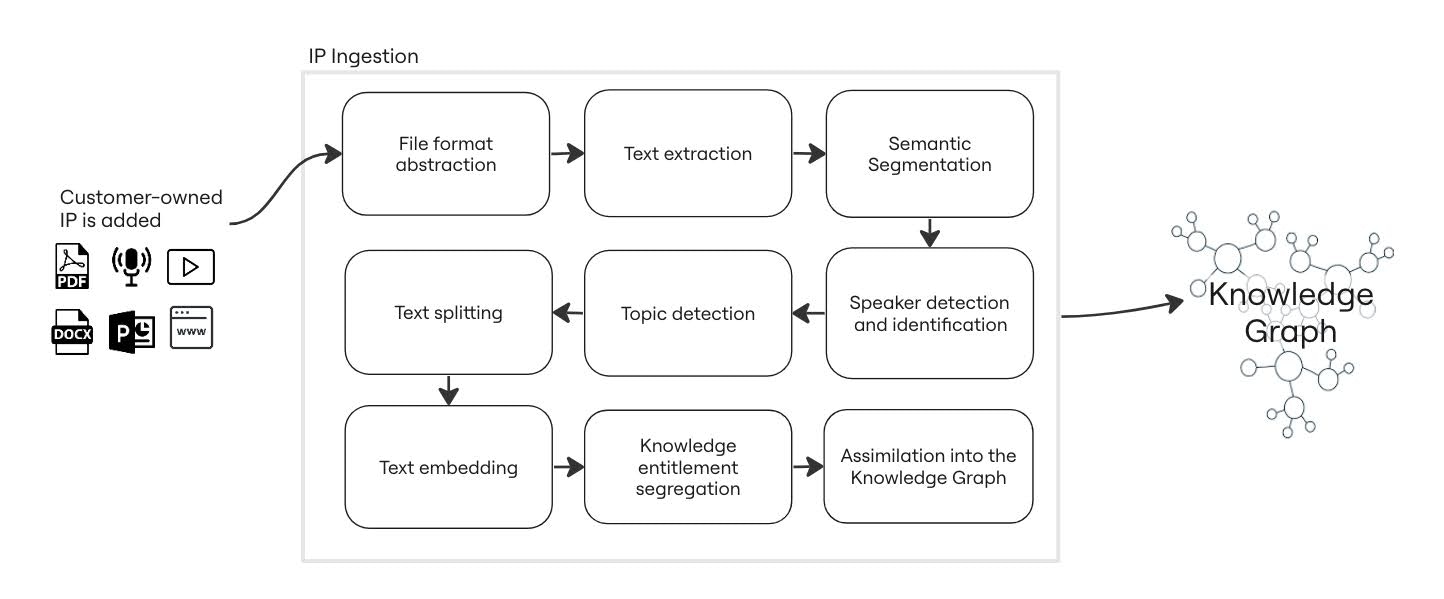
- Assimilated IP is never used to train any LLM shared between clients nor used for any process other than answering questions posed by users of the Agents created by your organization for your purpose.
- Data is stored in GCP (Google Cloud Platform) hosted databases and secured with row-level security, which Google manages.
MINDSET AI KNOWLEDGE GRAPH
The Mindset AI Knowledge Graph is a collection of different databases; each used to aid the efficient and contextual retrieval of client IP document fragments. This collection stores IP such that the contents and the context of information are equally important.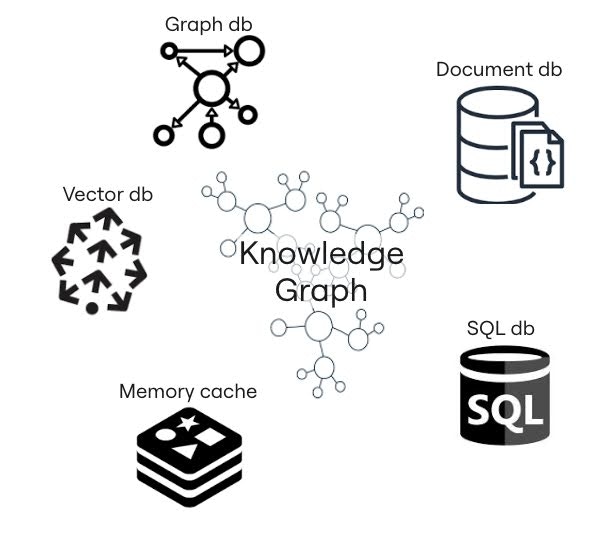
USER INTERACTIONS WITH THE KNOWLEDGE GRAPH
Users interact with the Knowledge Graph through an embedded chat interface where they can get answers to their questions (“Ask”) and also trigger predefined actions (“Do”).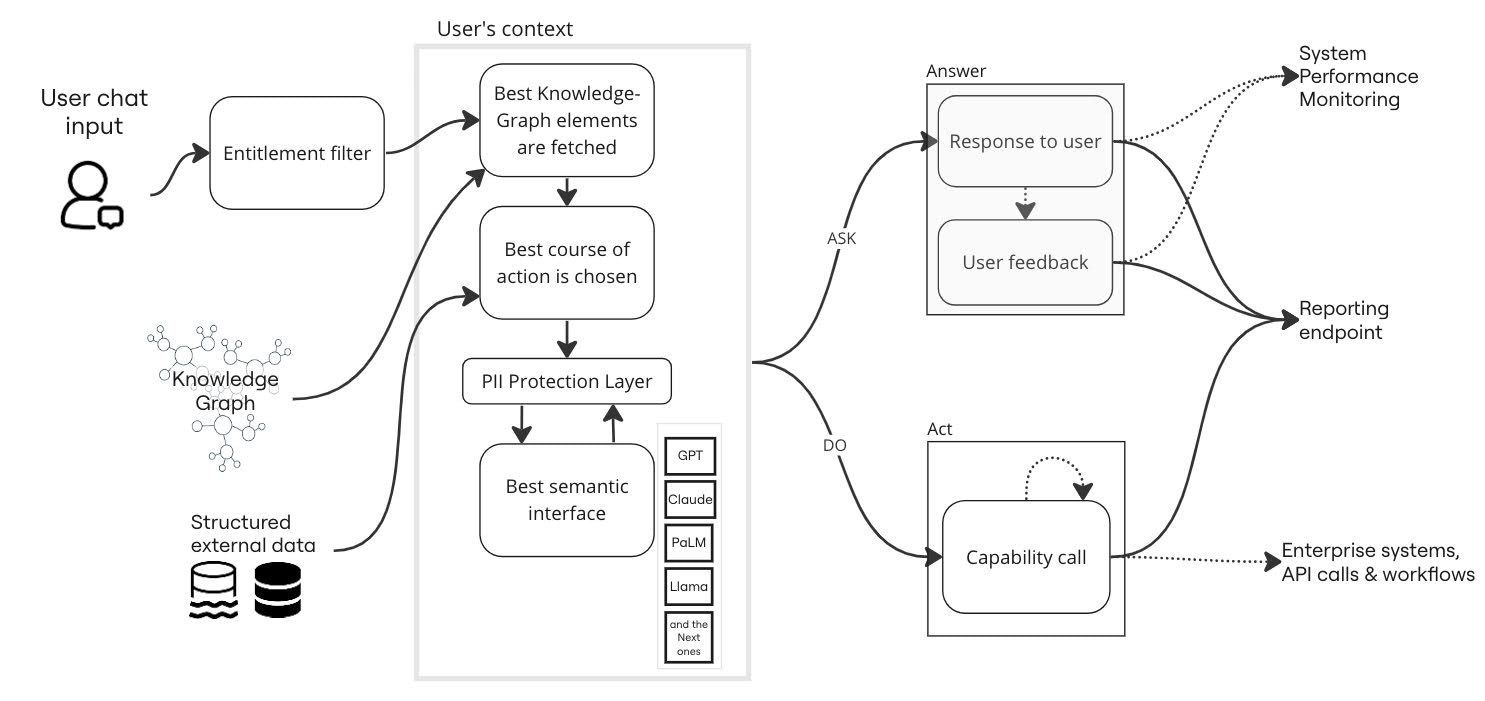
How do you ensure humans understand when they are interacting with AI?
Each interaction with an Agent starts with a Disclaimer message, which explains that the Agent is an AI and the specific limitations of the Agent.What are your AI ethical principles?
Our goal is to build an AI-powered system that is honest, helpful, and harmless. HONESTY- Accurately reflect the client IP: Enable our clients to craft knowledge bases containing accurate and reliable information.
- Transparency in Responses: We communicate the source of the information (answers) provided by the system, enabling users to zero in on the specific IP fragments that informed the system’s response
- User-centered Design: Our system is tailored to address user needs effectively. This includes understanding the context of queries and providing relevant and actionable responses.
- Personalization within Ethical Bounds: The system offers personalized responses where appropriate and ensures that personalization does not infringe on user privacy or ethical standards.
- Continuous Learning and Improvement: We use user feedback and interaction data to improve the system’s ability to provide helpful responses.
- Bias Mitigation: We regularly audit the system for biases in available content, content retrieval, and generation. This includes monitoring for gender, racial, cultural, or any other form of bias.
- Content Moderation: We have mechanisms for reporting instances where users feel the generated responses were wrong, biased, or inappropriate. These reports are routed to the appropriate stakeholders for action.
- Safety Protocols: We have protocols for handling sensitive topics, including directing users to human experts or authorities when necessary (e.g., in cases of legal advice, health emergencies, etc.)
How does the AI improve the user experience?
At Mindset AI, the AI enhances the user experience through real-time, context-aware responses, ensuring precision and relevance. Automated actions simplify processes, while grounded answers build trust. Iterative learning ensures continual enhancement, empowering users with accurate and helpful interactions. Where does the AI add value? VALUE TO USERS As a conceptual AI agent, the platform is designed to provide real-time, contextual responses, optimizing users’ access to the right information when needed. User questions trigger the generation of informational responses and predefined automated actions, simplifying various processes. VALUE TO CLIENTS Mindset AI provides several benefits to our clients, helping them deliver an enriched and seamless user experience. Mindset’s AI system strengthens our clients’ offerings by enabling them to offer real-time, informed responses via AI Agents. This aids in handling queries and automatically triggering actions based on user inputs. Integrating our clients’ IP into the secure Mindset AI Knowledge Graph gives them a sturdy system for managing their IP and providing value to their users. Firebase Authentication and our robust security framework guarantee the highest level of data security. Most importantly, our AI Agents work as a tool, helping clients shape informed decisions and stay in full control of the information flow. The context-aware system helps clients provide information and empower their users with knowledge. Finally, our iterative approach to integration eases maintenance and ensures seamless integration with various platforms, enhancing overall efficiency.Data Q&A
What data is collected?
At Mindset AI, we primarily collect data to enhance the functionality of our products and improve our user experience. We follow the principles of data minimization, only collecting pertinent data required for the product’s functioning. Here are the main types of data collected:- Client’s IP: The client’s IP is integrated into the Mindset AI Knowledge Graph. Our clients have a separate tenant in the Knowledge Graph that only they can access.
- Anonymized Usage Data: This includes anonymized user queries, usage metrics, user learning pathway data, user attributes, feedback metrics related to the chatbot, and general system usage. Collected usage data allows us to enhance system performance and provide more relevant responses.
- User-Specific Information: The information gathered during user onboarding and subsequent interaction with the system is used to personalize user experience, helping us tailor our responses to be more relevant and effective.
-
Human Facts Collection (Agent Memory): When enabled by administrators, our AI agents can collect and store contextual information about human users to enhance future interactions. This feature operates under a comprehensive three-tier control system:
- Application-Level Control: Administrators can enable/disable the Agent Memory feature globally across the entire application through the Beta section in the Admin Management Studio.
- Agent-Level Control: Individual agents can be configured to either access stored human context (“Access Shared Memory”) or contribute new facts to the shared memory pool (“Contribute to Shared Memory”). Administrators can also provide specific guidance to agents about what types of information to record.
- Human-Level Control: Each human user has granular control over their fact collection through a dedicated “Allow Fact Collection” setting, providing full opt-out capability at any time.
- User preferences (communication style, working hours, project priorities)
- Professional information (roles, responsibilities, expertise areas)
- Personal context (interests, goals, learning preferences)
- Communication patterns and interaction history
- Team relationships and organizational context
- Fact content and classification (Identity, Professional, Personal, Goals, Preferences, Communication)
- Collection timestamp and conversation context
- Source agent identification
- Modification history for GDPR compliance
- Right to Access: Complete visibility into all collected facts through dedicated admin interfaces
- Right to Rectification: Individual fact editing capabilities with full audit trails
- Right to Erasure: Both individual and bulk fact deletion with confirmation processes
- Right to Data Portability: One-click export functionality in machine-readable formats (CSV/JSON)
- Retention Management: Configurable data retention policies with automated cleanup capabilities
How is data used?
At Mindset AI, our primary focus regarding data usage is improving our products and services. Client-owned IP integrated into our Mindset Knowledge Graph is essential for answering user queries and informing automated actions. However, we assertively state that this data doesn’t contribute to training the commercial large language models (LLMs) that our system uses as a semantic interface. Instead, the training data for our LLMs is explicitly provided by an external LLM and stands independently of the client IP. Therefore, client data usage solely focuses on enhancing services specific to the client. Agent Memory Data Usage: When the Agent Memory feature is enabled, collected human facts are used exclusively to:- Enhance Personalization: Provide more contextually relevant responses by understanding individual user preferences, communication styles, and professional contexts.
- Improve Continuity: Maintain conversation context across different agents and interaction sessions to reduce repetitive information gathering.
- Enable Context-Aware Assistance: Allow agents to reference previously shared information to provide more informed and helpful responses.
- Support Organizational Workflows: Help agents understand team relationships and organizational structures to facilitate better collaboration.
- Never used to train commercial LLMs or shared models
- Never shared between different client organizations
- Only accessible to agents within the same organization when explicitly configured
- Subject to immediate deletion when human users exercise their opt-out rights
- Used solely for the purpose of enhancing user experience within the specific client’s environment
How is data stored?
DATA STORAGE Mindset AI houses data using the Google Cloud Platform (GCP), leveraging a modern, serverless architecture to guarantee robust data security. Our use of GCP ensures that your data is retained in a highly secure, encrypted environment, offering state-of-the-art protection. We use Firebase Authentication, a robust service provided by Google, to manage authentications. With this, Mindset AI ensures that access to stored data aligns with our strict access control and governance policies. These meticulous measures keep your data secure, easily retrievable, and appropriately isolated, guaranteeing the integrity and availability of your data at all times. Agent Memory Storage Architecture: Human facts collected through our Agent Memory system are stored with enhanced security and isolation measures:- Hierarchical Storage Structure: Facts are stored in Firebase subcollections following the path
/apps/{appUid}/humans/{humanUid}/userFacts, ensuring complete client segregation and human-specific data isolation. - Structured Fact Documents: Each fact is stored with comprehensive metadata including fact content, classification categories (Identity, Professional, Personal, Goals, Preferences, Communication), collection timestamps, conversation context, and source agent identification.
- Audit Trail Preservation: All modifications, deletions, and access events are logged with immutable timestamps, ensuring complete traceability for GDPR compliance and security auditing.
- Row-Level Security: Leverages GCP’s row-level security features to ensure human facts are only accessible to authorized agents within the same client organization, with additional restrictions based on agent-specific memory permissions.
- Encrypted at Rest and Transit: All Agent Memory data benefits from GCP’s encryption standards, ensuring protection both when stored and when transmitted between system components.
How is data shared?
At Mindset AI, we believe conducting business with integrity includes maintaining transparency about our data policies: Data Sharing: We strictly follow a ‘No Third-Party Sharing Policy’. We do not share, sell, or trade our clients’ data with third parties or other clients under any circumstance. Your data and IP stays exclusively within the purview of Mindset AI to enhance the product we deliver and the services we offer you. Transparency: We prioritize keeping our clients informed if there are any changes to our data handling policies. Any updates in the data usage policies are shared promptly with our clients to ensure maximum transparency.What data protection regulations are followed?
Mindset AI is committed to ensuring compliance with data protection regulations, including GDPR and CCPA. We prioritize user privacy by adhering to strict data collection, storage, and usage guidelines in line with legal requirements. Our approach revolves around data minimization, ensuring that only essential data required for service improvement and personalization is collected. We maintain the highest level of anonymity and confidentiality in our data collection process, safeguarding user privacy and upholding ethical standards. Additionally, we inform clients about changes in our data handling policies, ensuring transparency and mutual trust. Enhanced GDPR Compliance for Agent Memory: Our Agent Memory system provides comprehensive compliance with major privacy frameworks: GDPR (European Union) Compliance:- Article 16 - Right to Rectification: Complete fact editing capabilities with 30-day response timelines and comprehensive audit trails
- Article 17 - Right to Erasure: Both individual and bulk fact deletion with immediate processing and third-party notification capabilities
- Article 20 - Right to Data Portability: One-click export functionality providing facts in machine-readable CSV and JSON formats
- Article 15 - Right to Access: Complete visibility into all collected facts through dedicated administrative interfaces
- Right to Delete: Complete fact deletion capabilities with 45-day response timelines
- Right to Correct: Individual fact modification with comprehensive validation and audit logging
- Consumer Request Processing: Automated workflows for handling data subject requests within legal timeframes
- PIPEDA (Canada): Access and correction rights with complete audit trail maintenance
- US State Privacy Laws: Virginia VCDPA, Colorado CPA, Connecticut CTDPA, and Utah UCPA compliance through standardized data subject rights implementation
- Response Timeline Tracking: Automated monitoring ensures all data subject requests are processed within legal timeframes (30 days GDPR, 45 days CCPA)
- Legal Basis Validation: System verifies processing grounds before any data deletion to ensure compliance with retention requirements
- Cross-System Coordination: Automatic notifications to relevant systems when personal data is modified or deleted
- Audit Trail Immutability: All compliance-related operations are logged with tamper-proof timestamps for regulatory audit purposes